| |
| |
|
How to organize SPACE and BALANCE?
|
| |
|
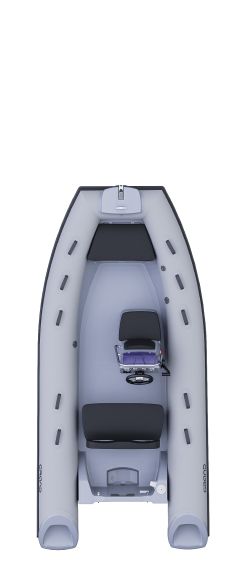
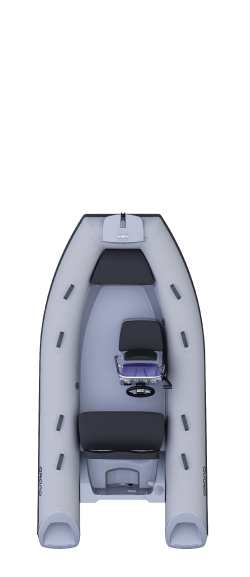
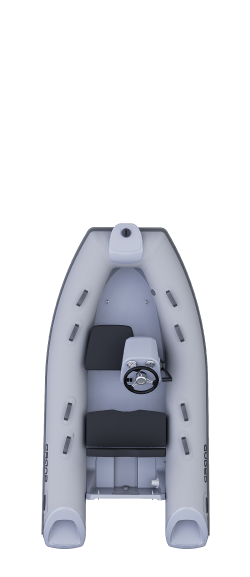
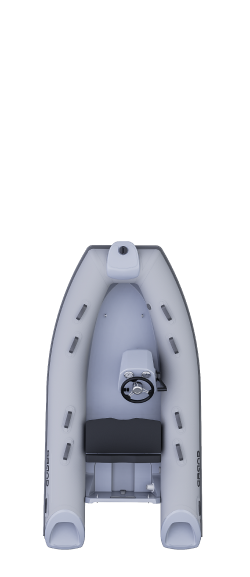
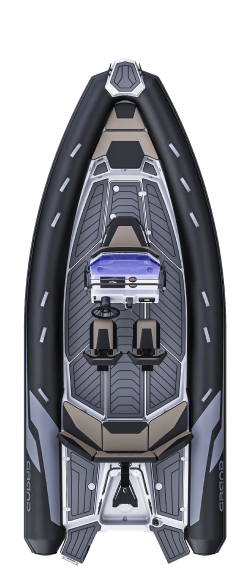
The problem of balance and space organization in a boat cockpit is quite serious for inflatable boats. The reason is very simple: the total
weight of an engine, a driver, passengers, a fuel tank and luggage is MUCH MORE THAN THE BOAT WEIGHT. So, what can we do with the balance ?
THE RULES ARE VERY EASY :
• TRY TO DISTRIBUTE ALL THE LOADS UNIFORMLY ALONG THE BOAT !
• AVOID CONCENTRATING THE MAIN LOAD IN THE REAR!
ENGINE - Engine is fixed on the transom, and there's nothing to do with it.
DRIVER - In case of an engine with the tiller control the driver is mostly sitting in the rear. That's not so good for balance. The best solution
would be to use the steering console with a remote control system, which can be installed in the middle or closer to the bow part. If it's
not possible, then the different kinds of tiller extensions can be used, but this solution is not so comfortable and nice as the previous one.
FUEL TANK - Some types of engines have a especial place for fuel tank installation. But very often it's a matter of your choice. The best way
to compensate the rear part weight concentration is to place the fuel tank in the bow part. This will be very helpful especially when you drive
an empty boat and the tank is full. Of course it is not necessary to do so when the tank is empty.
PASSENGERS - In order to reach the balance just place all the passengers evenly in the cockpit and do not allow them to crowd in one place.
LUGGAGE - Bow part, only bow part is the place! By the way - do not forget to take a kind of cover with you to protect the luggage from water
sprays when you go for a ride!
|
| |
|
"Before you start"- CHECK LIST
|
| |
|
At last everything is ready to go and you have the last moment for a final check. It's much better to recognize a problem on the shore than
in a ride, when it can be too late. So, before you start, please make a final check and make sure of the following:
1. WEATHER:
- There's no storm warning and the weather forecast is positive
- Wind and waves are not too strong for you and your boat
2. PASSENGERS:
- Ask all the passengers if anybody can not swim
- All passengers should know how to operate the boat in general, and at least one of them must be able to do it well
- Everybody has the Personal Flotation Device (PFD) clothed properly
- Everybody has the correct clothes for boating, which corresponds to the current weather conditions. Explain to your passengers that it is
always colder on the water than on the coast.
3. LUGGAGE:
- The luggage is carefully closed and securely fixed inside the cockpit. If necessary, take a cover with you to close the luggage against water
sprays and rain
- Luggage doesn't impede passengers to move inside the boat.
4. THE BOAT:
- The pressure in the tube and other inflatable compartments is nominal, and all the valves are closed with caps tight
- There are no any defects/damages in your boat, especially in the transom area
- You have the oars (paddles), an inflation pump and a repair kit with you.
5. THE ENGINE
- Motor clamps are tightened hard and the engine is attached to the transom with the safety lanyard
- You've got at least two ENGINE STOP SWITCH LANYARDS with you (one main plus a spare one)
- You've served your engine in time and you've got the oil in reduction gear.
6. FUEL
- Fuel and oil tanks are full.
ATTENTION!!! In case you go far from the coastline, the quantity of fuel you take should be enough for a double distance to the place of destination
to turn back in case of emergency. If your tank volume is not enough - take more fuel tanks/cans with you.
- All the fuel tanks you have are strongly fixed in the cockpit
- Fuel tanks, fuel lines, a fuel pump and connectors are in good condition without ANY FUEL LEAK.
7. DOCUMENTS
- You've got with you your boating license and boat documents
- You've got a marine map of your boating area (if necessary).
If everything is OK - YOU CAN GO !
|
| |
|
Boat PLANING and "PRANCING" effects
|
| |
|
Speaking about the operation of inflatable boats it's necessary to say some words about such important things as aquaplaning and prancing effect.
What are they? To understand it just let's look how the boat moves on the water.
There are three typical stages of every boat run: a DISPLACEMENT STAGE, a TRANSIENT STAGE and a PLANING STAGE.
Some more details:
DISPLACEMENT STAGE.
On a displacement stage the boat floats just due to the Archimedes force as a result of water displacement. It's a stage, when the boat stays
or moves slowly. The water resistance here is quite low.
TRANSIENT STAGE.
This stage is between planing stage and displacement. Have you ever seen how jet plane starts? It's something similar. To pass this stage through
you need the full throttle (or nearly full). In case the engine is powerful enough the boat starts moving quicker, lifting the bow part up
(same as a plane!). At this moment the water resistance grows up the maximum with the highest angle of a bow part lifting up (this effect is
called as "prancing"). And then it looks like in a moment the boat "JUMPS" out of the water and starts planing very fast and easy.
PLANING STAGE.
On a planing stage the boat floats just due to hydrodynamic lifting force, caused by the contact of water with moving boat bottom. The water
resistance is lowest, whicht allows to reach the maximum speed.
For an illustration please look at the drawings above.
The first picture shows which engine power is necessary to keep the different speeds. You can clearly see a hump - hump of
resistance. After the boat reaches the maximum it starts planing and needs less power to keep the speed. It means that the boat needs more
power for speed of 10 km/h than for 15 km/h. A paradox? No, it's TRUE! On displacement and transient stages the contact area of the boat with
the water is more than on planing, which means much higher resistance, so it takes more power.
There are two curves: the green curve corresponds to a boat with a good balance, or a heavier one, and the red curve - to a boat with a bad
balance or a lighter one. Do you see the difference?
The second picture shows the change of a boat attack angle as a function of speed. The red curve shows the boat with a bad balance or a heavier
one. The green curve - a boat with a good balance or a lighter one. The "prancing" effect is very clear here. It is typical for all the planing
boats. Unfortunately it's quite dangerous. At this moment the risk of boat overturn is highest. BE CAREFUL!!!
There is also one mistake, which stimulates this effect - wrong space organization, when the maximum load is concentrated on the rear. And
there's only one recommendation to minimize the prancing effect: TRY TO MOVE THE LOAD TO THE BOW PART.
|
| |
|
How to set the right engine trim angle ?
|
| |
|
Every boat is very sensitive to the the angle of the engine shaft, set by trim. When it's wrong this either sufficiently decreases the performance,
or makes your boating much more risky. By adjusting the angle of the trim try to find the most optimum and stable position for your engine.
A) When the Engine is fixed too low - the bow part goes down, splashing a lot.
B) When the Engine is fixed too high :
• The bow part goes up
• The boat hull starts loosing the contact with water, decreasing stability and increasing the risk of overturn
• The propeller starts taking air, what causes the propeller Aeration
C) THE OPTIMUM TRIM :
THE BOAT GOES STRAIGHT, FAST, WITH GOOD CONTACT WITH WATER WHEN THE ENGINE SHAFT STAY VERTICAL
|
| |
|
Propeller Aeration (Cavitation) effect
|
| |
|
The AERATION effect, sometimes by mistake called as "Cavitation", means taking air by propeller with the following sudden engine
RPM increase over the limit. You may know that due a sound of sudden motor howling on sharp turns or some similar situations. First of all
Aeration is quite destructive for the engine by itself and disturbing to all the people around. There are some reasons, which cause or stimulate
Aeration:
If you face the aeration effect, which seems to be non-acceptable, and the transom height is right, then try one of the following steps:
• Make sure the engine is installed in lowerest position on a transom possible,
• Lower the engine shaft with trim to one of lowest positions,
If this will not help, then you can try some other steps:
• Install a hydro-foil on the engine.
The hydro foil makes the nose trimmed down, because now the angle of attack of the bottom
vs water line is less, the air bubbles are pushed less downwards
• Install a higher pitch prop and 1 size bigger diameter.
The standard installed props are normally designed for normal fibre glass or alu boats
with much more water displacement. A bigger and a higher pitch has a calmer hydro flow around the prop.
|
| |
|
How to tow the boat right ?
|
| |
|
Of course, you can just fix the rope to the bow ring and go, as usual. And there's no problem to do it when you have to pass 100m from one
place in your marina to another. But when you are on a long distance cruise in the open sea - the matter of towing becomes top important as
the chance to find just empty rope instead of your lovely dinghy in the rear is more than realistic. So, how to tow the boat? What is wrong,
what is right:
1) PRIMITIVE towing. This way is the worst of any possible. It can be used just for a very slow move (till 5km/h) on calm water for a short
distance with the direct supervision. With a faster move the boat can loose stability and start oscillatory motions, which can cause the destruction
of towing eyes, boat overturn or damage. Be cotious doing that.
2) SMART towing. In this case a tow line is connected with a boat via a loop or an eye and the rope, which is fixed to two towing eyes on tube
sides and moves free in the towing line loop as a "bridle". This way totally excludes any possibility of out-of-control moves of a boat and
gives a possibility to tow the boat with the maximum speed available without any problems. We recommend you this way of towing as the main
one.
3) "TOP SAFE" or "STORMY" towing. We recommend this manner to you especially for long-distance cruises in the open sea, where there's no chance
to find a towed boat if it's lost. By this method the ends of a "bridle" rope pass the bow tow rings through, go under the bottom, and are
fixed to the transom directly. This is the strongest and safest way to tow a boat (even the normal towing eyes are quite strong, but in rough
waters the possibility of sudden and extraordinary strong hitches, which can broke the towing eye, is quite high - it's better to use the strongest
solution.
4) In case you have to tow someone : fix the bridle loop on your transom and and joint it with the main towing rope by means of metal ring
/ eye, or any other way, when the main towing rope can easily move along the bridle loop. It will give you a chance to stabilize your movement,
especially when you change the direction.
|
| |
|
How to do Anchoring ?
|
| |
|
Anchoring the inflatable boat is easier then the conventional, because the inflatables are lighter. For effective anchoring you need some things
: anchor, some steel chain, couple of shackles and the anchor rope.
• ANCHOR TYPE. There are a lot of anchor types in the market and mainly all of them are good. But having an inflatable try
to choose the type without sharp edges / parts to avoid the buoyancy tube damage.
• ANCHOR WEIGHT. Having the small boat till 6 m (20') long and with the total weight up to 1000 kg (2200 lbs) you can use
the simple formula to choose the acceptable anchor weight
FOR BOATS TILL 3.0 m LONG = 4-5% OF THE TOTAL BOAT WEIGHT
FOR BOATS FROM 3.0 m till 6.0 m LONG = ABOUT 3 % OF THE TOTAL BOAT WEIGHT
FOR BOATS OVER 6.0 m LONG = 1-2% OF TOTAL BOAT WEIGHT If you are in doubt - choose the heavier one. It will pay you !
• CHAIN. The chain is not necessary for small boats, BUT MUCH PREFERRED !!! Take 1.5-2 meters (5'-7') of proper chain and
you will see the difference: it increases the effectiveness up to 1.5-2 times.
• ANCHOR ROPE. There's nothing special, juts make sure that it's strong and long enough. If you need the anchor to hold you
on place firm - the length of the rope should be at least 10 times more that the depth under the boat. In this case the anchor will do his
best for you.
In case of anchoring in bad weather (rough waters with strong wind) or when you need to keep your boat position fixed - it's likely to use
two anchors. it will take a bit more time to set them , but you will be really on place.
|
| |
|
How to LIFT the boat ?
|
| |
|
The question "How to lift the boat?" means "HOW NOT TO DAMAGE THE BOAT AND KEEP EVERYONE AROUND YOU SAFE, WHEN YOU LIFT IT?". Very often wrong
lifting causes the boat or its parts damage and may be dangerous for you and people around you. There are some pieces of advice how to lift
the boat properly and safe, and some typical mistakes to avoid:
• Never lift the boat with people onboard.
• Never lift the boat with the running engine.
• Never lift the boat, when there are any people in the water close to the boat.
• Maximum load capacity of your lifting system should be more that the total boat weight.
• For lifting use only the eyes intended for lifting : lifting eyes on the transom, lifting eyes on the rigid hull, lifting
eyes specially installed in the buoyancy tube. If your boat doesn't have them - install them before go boating.
• Never use the towing eyes to lift the boat.
|
|
|
|
|
|
|
| |
|
HAVE A PLEASANT & SAFE BOATING !!! |
<
| |
|
|
|
|
|